

Every industrial process that runs hot has to send that heat somewhere. Production lines, compressors and server racks all generate heat as they work, and if that heat is not removed, equipment performance starts to suffer. When the water in a system rises by only a few degrees, the effects follow quickly. Motors work harder; output falls, and a process that ran well in the morning can be struggling by the afternoon. The cooling tower is the part of the plant that keeps that heat under control, yet it rarely gets much attention until the day it stops. So, what is actually happening inside one?
What Does an Industrial Cooling Tower Actually Do?
An industrial cooling tower has one core function. It removes heat from water so the rest of your system can stay at temperature. Warm water leaves your process or your chillers; the tower cools it, and the same water returns to take on the next load. The cycle runs continuously around the clock.
Cooling towers are used wherever heat needs to be removed reliably. Manufacturing plants, food and drink sites, power stations and data centres all depend on them. The application varies, but the range of cooling tower applications shares the same underlying need, removing unwanted heat before it affects performance and cost.
The Cooling Tower Working Principle, Step by Step
The cooling tower working principle is based on evaporation. When a small amount of water evaporates, it carries a significant amount of heat away with it. A cooling tower is designed to make this happen quickly and at scale.
Warm water enters at the top and is spread across the fill, the packed surface inside the tower. As it moves down, air passes through it and a portion of the water evaporate, taking the heat with it. This is evaporative cooling in action. As the air leaves, it carries fine droplets, so drift eliminators capture them and return them to the system, reducing water loss. The cooled water collects in the basin and is pumped back to your process, and because each cycle loses a little water to evaporation and drift, make-up water tops the system up.
Performance depends on every stage doing its job. If the fill scales up or the drift eliminators deteriorate, the whole tower loses efficiency. Each of the cooling tower components has a role to play, which matters most when a tower stops reaching temperature.
How Does a Cooling Tower Work Alongside a Chiller?
Cooling towers and chillers are often confused, but they perform different roles. A chiller produces cold water to cool your building or process directly. A cooling tower removes the heat the chiller has extracted and releases it to the outside air. In short, the chiller provides the cooling, and the tower rejects the heat.
The two are connected by the condenser water loop. Heat collected by the chiller travels along that loop to the tower, is released through evaporation, and the cooled water returns to begin again. In a commercial building, a cooling tower for an HVAC system sits at the end of that condenser loop and rejects the heat to atmosphere, allowing the chiller to keep producing chilled water.
How Draught Type Changes the Way a Cooling Tower Works
The way a tower moves air affects how it performs, and that is determined by draught type. Forced draught towers use fans to push air in. Induced draught towers use fans to draw it through. The choice affects where the fans sit, how much power they use and how well the tower suits a restricted or noise-sensitive location, which is why forced draught versus induced draught matters during specification.
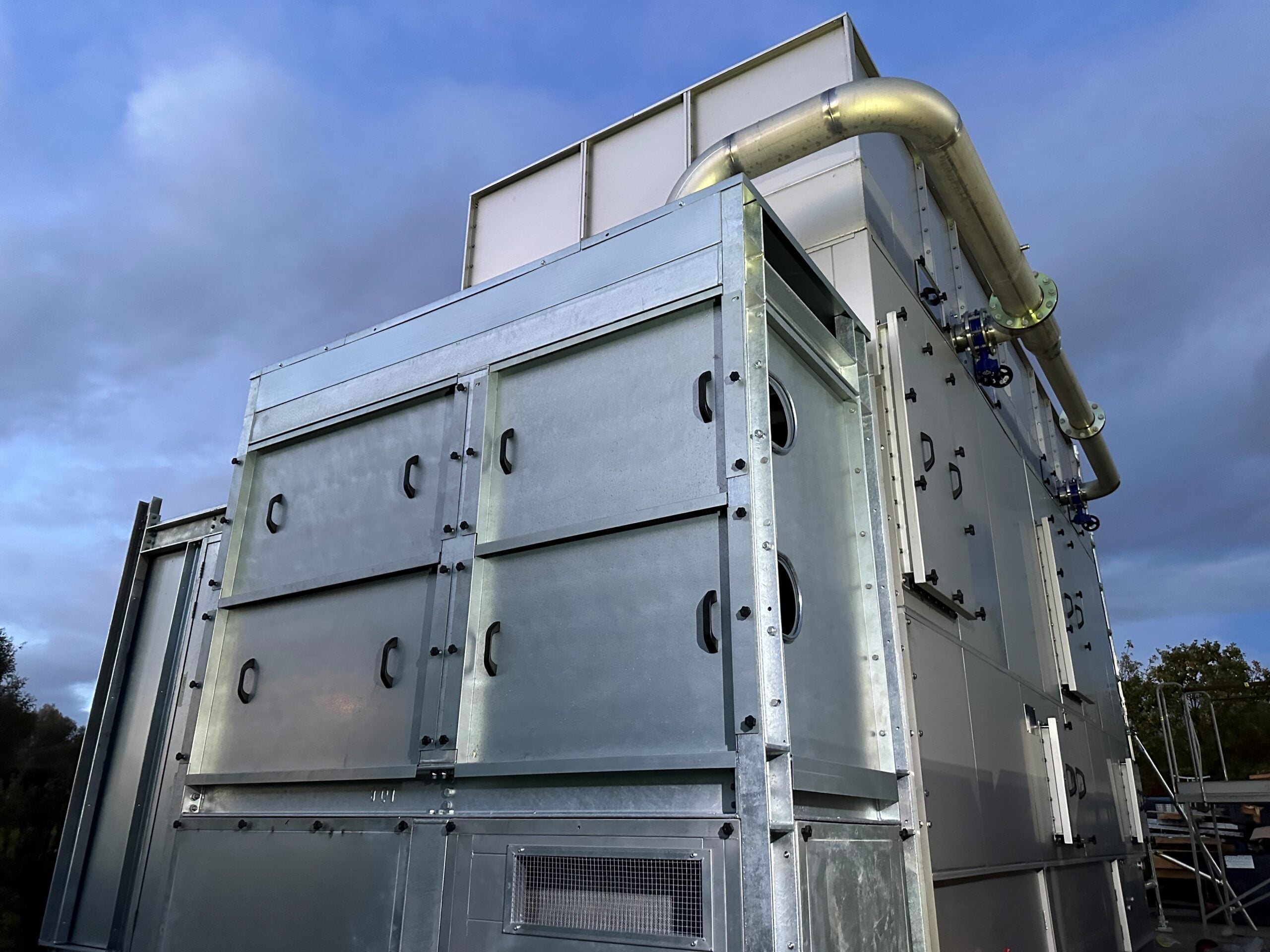
Our Carter Environmental cooling towers cover both designs across the BAL, BUC and SAN series, all evaporative and rated from 6 to 600 cubic metres per hour in open or closed-circuit form. Where water is limited or costly, the approach changes. A dry air blast cooler rejects heat across a sealed coil using air alone, and our WABC adiabatic cooler wets the incoming air only during warmer periods, keeping water use low while maintaining performance on the hottest days.
What Keeps an Industrial Cooling Tower Running Efficiently?
Efficient cooling tower operation depends on keeping the water clean and the airflow clear. Two issues build up over time. Scale forms on the fill and coils and restricts heat transfer, while fouling coats the same surfaces with dirt and biofilm. Both force the tower to work harder for less cooling, which increases energy use. A consistent cooling tower water treatment programme keeps the water and surfaces in good condition.
Wet systems also carry legal duty. The fine spray a tower produces can carry Legionella bacteria if the water is not properly managed. UKHSA recorded 472 cases of legionellosis in England and Wales in 2024. Anyone responsible for a wet cooling tower must control that risk, and the HSE’s Approved Code of Practice L8 and guidance HSG274 explain how. Well-managed water and intact drift eliminators are central to remaining compliant.
Keep Your Industrial Cooling Tower Working at Its Best
A cooling tower is only as effective as the design behind it and the maintenance it receives. Match the type, the draught and the water treatment to the site, and it will hold temperature reliably for years. Get any of those wrong, and it becomes the weak point the rest of the system depends on.
Franklin Hodge has designed, built, and supported cooling towers for more than 50 years, on industrial sites across the UK and worldwide. Tell us your heat load and site requirements, and we will respond with the right specification. Request a quote and our team will take it from there.