

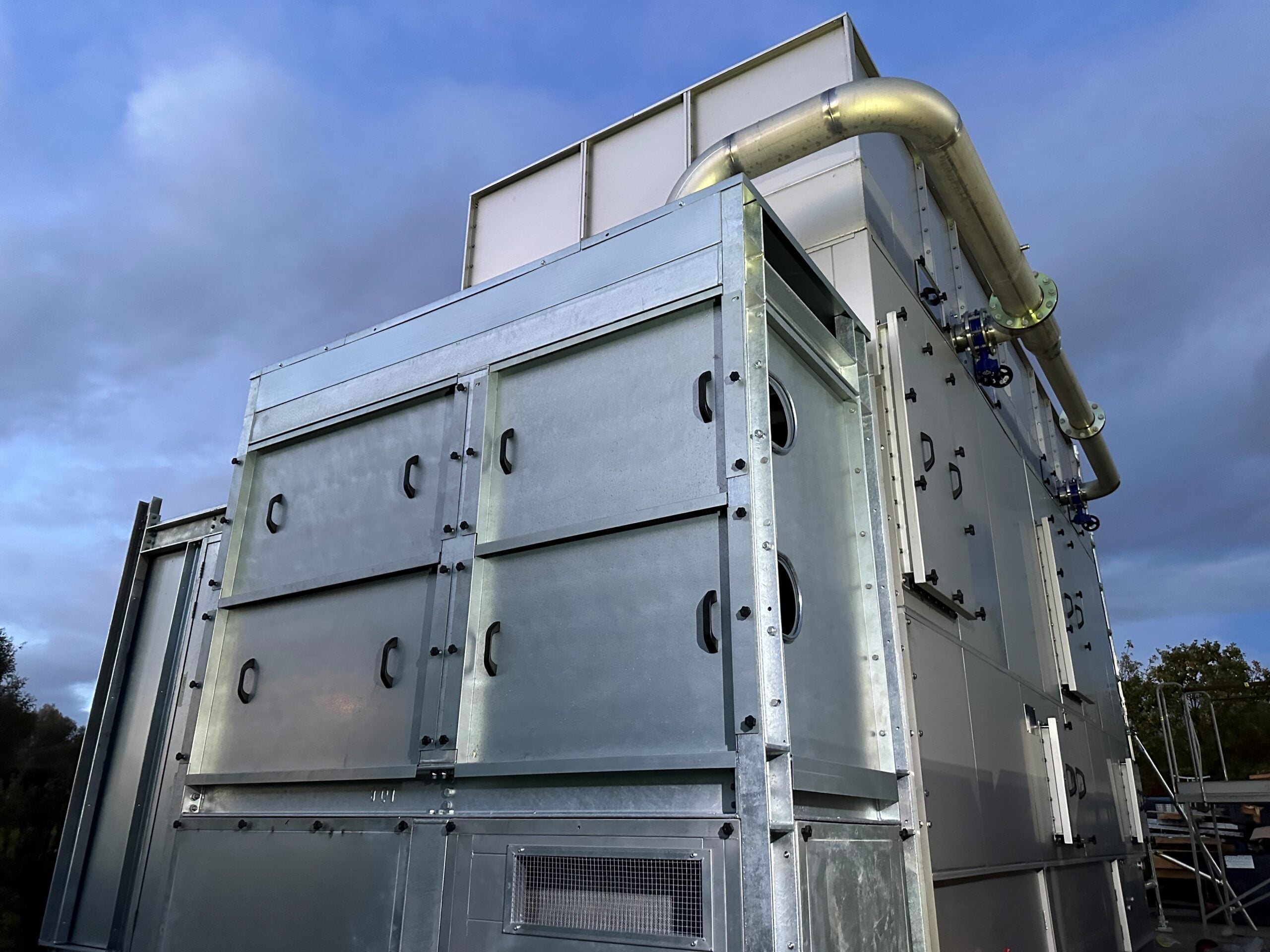


Two cooling towers can look almost identical on a quote and perform nothing alike once they are running. Most buyers compare price and lead time, then wonder why one tower costs more to run, takes up more space, or needs a crane to service. The difference is design, and it comes down to two things you can choose: how air is driven through the tower, and the direction that air travels against the water. Get those right for your site and the tower earns its keep for decades.
Understanding the Main Cooling Tower Designs
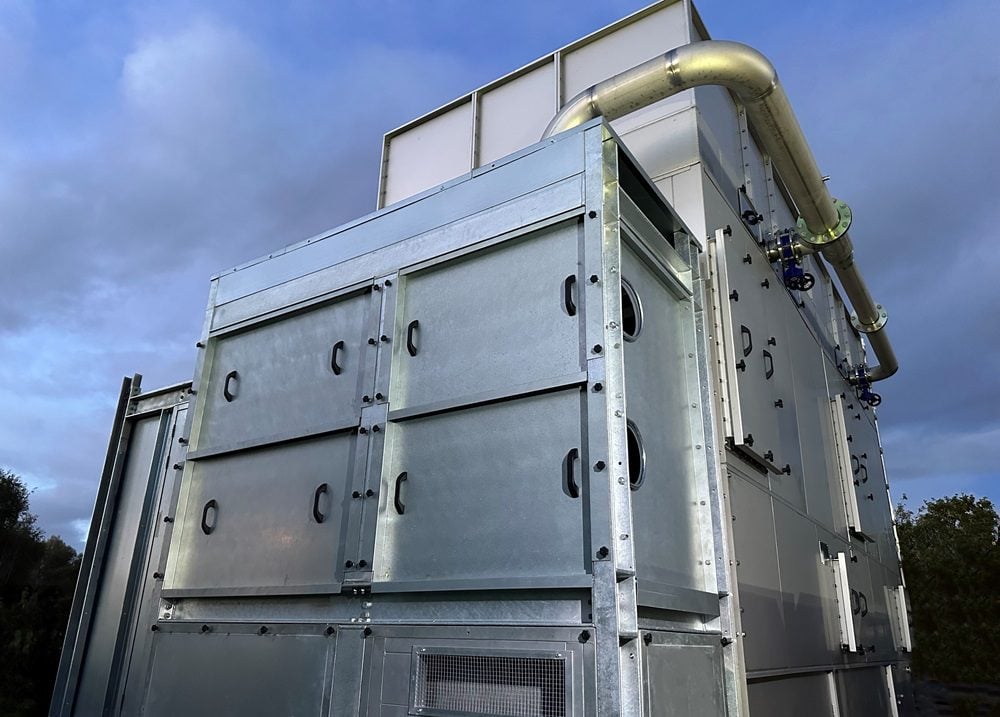
Most industrial towers are mechanical draught evaporative towers: a fan moves air through the tower while warm water is cooled by evaporation. From there, two choices define almost everything about how a tower behaves. The first is how air is driven, by a fan that pushes air in or one that pulls it through. The second is how air meets the water, either across it or against it. Those two axes give you the forced, induced and counterflow designs worth comparing. Franklin Hodge (Carter Environmental brand) builds evaporative cooling towers across this range, from 6 to 600 cubic metres of water an hour.
Forced Draught vs Induced Draught Cooling Towers
Forced draught towers put the fan at a low level and push air into the tower. Induced draught towers mount the fan at the top and draw air up and out. The tradeoffs are practical. Forced draught keeps the fan and motor low down and easy to reach, which helps maintenance access. Induced draught tends to give even air distribution with the fan up top. The Franklin Hodge range covers both: the BAL series uses low-level centrifugal fans and the SAN series side-mounted axial fans for forced draught duties, while the BUC series uses a top-mounted axial fan for induced draught. The cooling tower fans you choose shapes noise, energy use and access as much as the tower body does.
What Is a Counterflow Cooling Tower?
A counterflow cooling tower sends air straight up against the downward flow of water. Water falls through the fill while air rises to meet it, which gives efficient heat transfer in a compact footprint. The whole Franklin Hodge evaporative range, BAL, BUC and SAN, is counterflow by design. The air and water meet head-on for maximum contact, and the tower stays tight on space. Counterflow also lends itself to enclosed water distribution, which supports cleaner, more hygienic operation over the life of the tower.
Counterflow vs Crossflow: How Air and Water Meet
Crossflow is the main alternative. In a crossflow tower, air moves horizontally across the falling water rather than up against it. Crossflow units often have open water distribution decks that are easy to inspect, but they can be more exposed to sunlight and debris, which affects water hygiene. Counterflow keeps water enclosed and the contact efficient, which is the configuration Franklin Hodge supplies. Hygiene is not a side issue here. The HSE lists cooling towers among the systems where legionella can grow, with bacteria favoured at water temperatures between 20 and 45°C, so a design that controls water distribution and cuts drift is part of running a tower safely.
Which Cooling Tower Design Is Right for Your Site?
The right design follows your duty, not default. Weigh these together: your flow rate and heat load, the footprint and height you can give it, energy use and noise limits, water quality and treatment, and how easily you can reach the tower to service it. A high-throughput site tight on space leans one way; a site with easy access and strict noise limits leans another. Because Franklin Hodge builds each Carter Environmental cooling tower to your duty rather than a catalogue, the configuration is matched to the site from the start.
Specify the Right Cooling Tower for Your Site
The cheapest tower on the quote is rarely the cheapest tower to run. Design decides footprint, energy use, service access and how well the tower holds up, long after the lead time is forgotten. Franklin Hodge engineers each counterflow tower around the duty in front of it, so the configuration fits your site rather than the other way round. Tell us your heat load, flow rate and site, and the team will specify a cooling tower to match.