Get the cooling choice wrong, and you pay for it twice, first in fouled equipment and corroded pipework, then in the downtime that follows. Many industrial processes rely on a fluid that must stay clean. The moment that fluid meets open air it starts picking up dust, debris and biological growth, and the whole system pays the price. For those processes, keeping the fluid sealed changes everything, and that is where a closed-circuit cooling tower earns its place.
What Is a Closed-Circuit Cooling Tower?
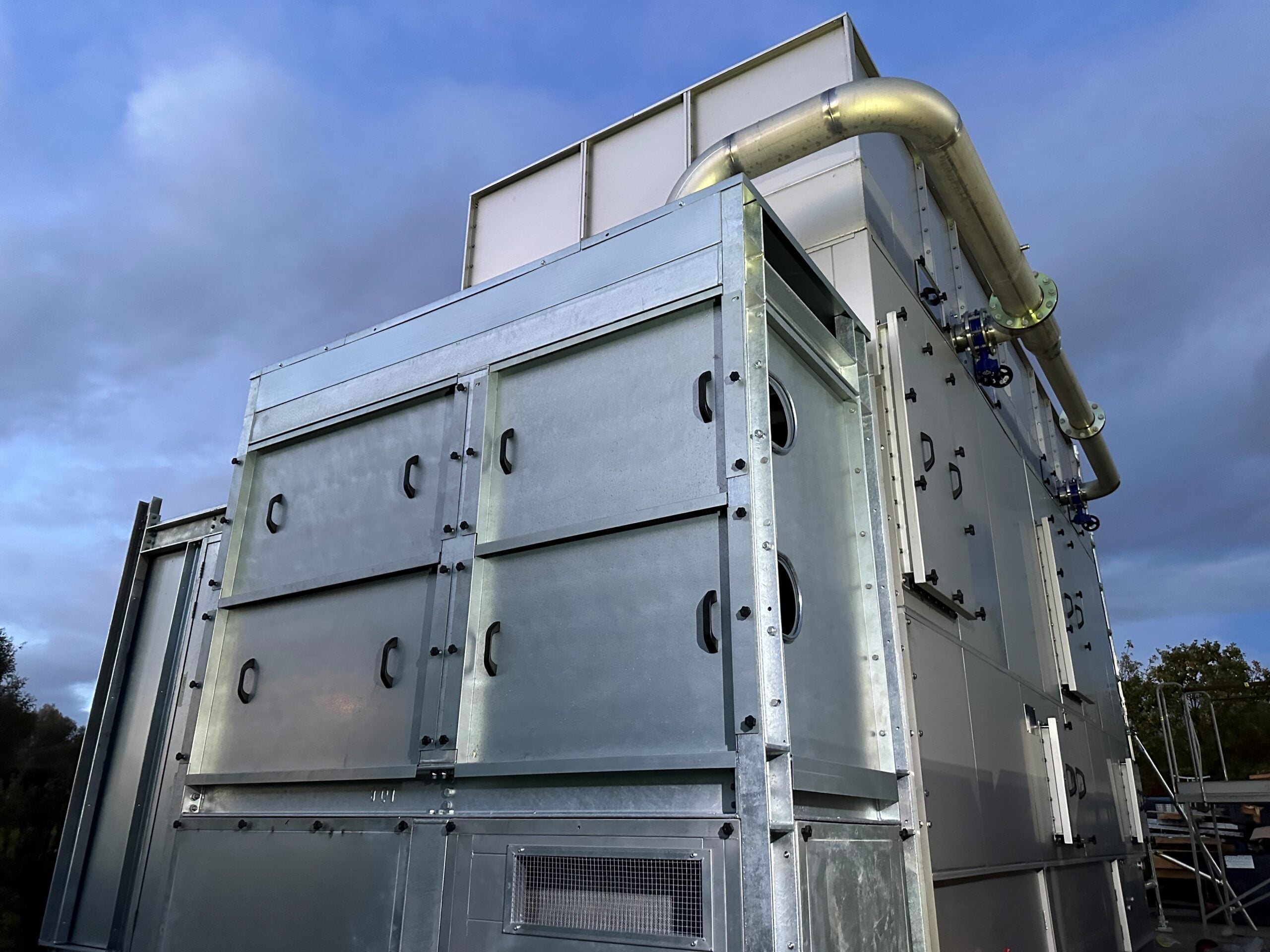
A closed-circuit cooling tower cools your process fluid without ever exposing it to the open air. The fluid runs through a sealed coil inside the tower, and that coil is cooled from the outside by a separate spray-water and air circuit. Your fluid stays clean and contained from start to finish.
That is the core difference from an open circuit tower, where the process water is sprayed directly across the fill and meets the air head on. Both reject heat well. The closed loop simply keeps your primary fluid out of contact with everything around it. For the wider context, our guide to what cooling towers are used for sets out where each type fits.
Closed-Circuit vs Open Circuit: What’s the Difference?
Neither type is the wrong choice on its own. They suit different priorities, so the right call depends on your process and your site.
- Open circuit: compact, lower upfront cost and very efficient. The trade-off is that the process water meets the air, so it picks up contamination and needs more water treatment.
- Closed-circuit: keeps the primary fluid sealed and clean, which cuts fouling and treatment in that loop. The trade-off is a larger footprint and a higher initial spend.
- Dry cooler: rejects heat through a coil with no evaporation at all, using the least water. It runs warmer than an evaporative system, so it suits sites where water saving outweighs peak cooling performance.
In simple terms, open circuit wins on cost and size, closed circuit wins on fluid cleanliness, and a dry cooler wins on water use.
When a Closed-Circuit Cooling Tower Is the Right Choice
A closed-circuit cooling tower is the right choice when keeping the fluid clean matters more than saving on footprint or upfront cost. It earns its place when:
- The fluid feeds sensitive equipment that fouling would damage
- The duty is food, beverage or pharmaceutical, where contamination is not an option
- The loop carries glycol or a treated fluid that must not be diluted or exposed
- Corrosion, fouling or freeze protection are real risks on site
- Water conservation or plume control is a stated priority
If two or more of these apply to your process, a closed loop is usually the sensible starting point. The next step is matching that decision to the right unit.
Franklin Hodge’s Closed Circuit Cooling Options
Franklin Hodge supplies closed circuit cooling under the Carter Environmental brand, designed and built at our Birmingham facility. The range covers two routes.
For evaporative duty, the Carter BAL and BUC cooling towers are each available in open and closed-circuit variants, from 6 to 600 cubic metres per hour, as single or multi-cell units. That range lets you match the tower to the heat load rather than force the load to fit the tower.
For fully dry, water-saving duty, the Carter ABC and WABC dry air blast coolers are closed circuit coolers built with copper or stainless-steel coils. The WABC adds a adiabatic cooler mode that pre-cools the incoming air and pulls the fluid outlet temperature below the ambient dry bulb when peak performance is needed. That adiabatic package sits on the WABC alone, so you get dry running for most of the year with extra capacity on the hottest days.
Keeping a Closed-Circuit System Efficient and Compliant
A closed loop protects your primary fluid, but any evaporative unit still has a spray-water side that needs managing. That side carries the same legionella duty as any wet cooling system, so it falls under the same controls. A fully dry cooler avoids the spray-water side altogether, which cuts both water use and legionella exposure.
This is where the compliance picture matters. The HSE’s HSG274 guidance advises duty holders to replace a wet cooling tower with a dry system where it is reasonably practicable, precisely because removing the water spray removes the risk. Where a wet system stays, a managed water treatment programme keeps it clean, controlled, and compliant. Wet cooling towers and evaporative condensers are also notifiable to your local authority under the 1992 regulations, so this duty is a legal one, not just good practice.
Choose the Right Closed-Circuit Cooling Tower for Your Site
The right closed-circuit unit depends on your fluid, your heat load, your site conditions, and your water position. Get those matched properly and you protect the process for years, not months. Franklin Hodge designs, supplies and supports closed-circuit cooling towers and dry coolers for industrial sites across the UK and internationally, and we back every unit with servicing for the long term. Tell us about your duty and contact our team to specify the right one